
How to Easily Track and Pay Your Payoneer Payment Requests
Do you regularly receive payment requests from freelancers, contractors and other service providers? Paying and tracking those payment requests just got easier! 2. Check out tools to track and manage your payment requests On the Payment Requests Received page, you’ll discover a number of tools to track and manage the payment requests you have received:…


Do you regularly receive payment requests from freelancers, contractors and other service providers? Paying and tracking those payment requests just got easier!
2. Check out tools to track and manage your payment requests
On the Payment Requests Received page, you’ll discover a number of tools to track and manage the payment requests you have received:
- In the main table, view all of the payment requests you have received. Payment request statuses are updated in real time. If you have unpaid payment requests, you can quickly see the three most recently received requests in a separate table at the top of the page.
- Select any request to see its details in the right pane.
- Pay any pending payment request by selecting it and clicking Pay in the right pane.
- Use the search and filters to help you find specific requests. For example:
- Filter by Past due? > Yes to see all unpaid payment requests whose payment due date has passed.
- Filter by Status > Paid to see all payment requests that have been paid in full.
- Search for a specific request by receiver name or request ID.
- View all the payment methods you have used to make payments. Click Settings in the left menu, then Payment Methods.
3. Pay a payment request
3a. Click a payment request whose status is Request pending.
3b. Review the details in the right pane and click PAY at the bottom.
The Payoneer Online Payments application opens and you can now pay quickly and easily without having to complete all the details, as you had to before. (For security reasons, you will still need to provide credit card CVV or bank account number.)

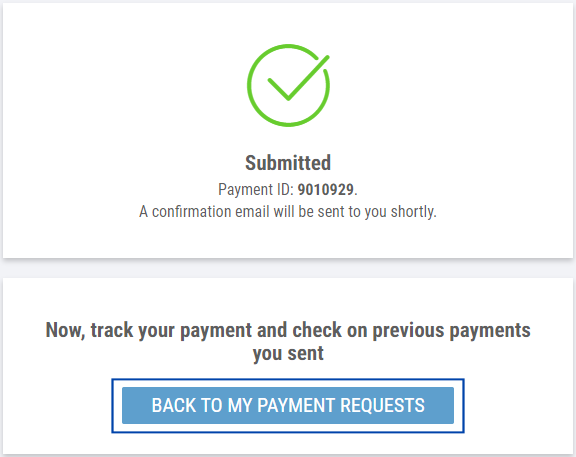
3. After paying, click the BACK TO MY PAYMENT REQUESTS button to quickly return to the table of payment requests received, where you can pay additional requests.
To see how you can track the status of your payment requests, watch this video:
Paying future payment requests
Sign in regularly to check the status of your payment requests and pay any new payment requests you receive. Bookmark the URL https://login.payoneer.com. You can also pay quickly from payment request emails – just remember to sign in for fast paying.
Related resources

The Future of the Global Creator Economy and the Payment Gap Holding It Back
The creator economy is growing worldwide, but cross-border payment challenges still slow creators down. Learn how modern payout infrastructure helps creators access earnings faster and grow globally.


Test: Global money transfers: How to make safe international transactions
In our interconnected world, global money transfers are an essential part of business and personal finance. Whether you’re a small business owner expanding into international markets, a freelancer working with…

Making International Payments From Pakistan: The Methods, Steps and Best Practices
Learn the best ways to send and receive international payments from Pakistan, including secure methods and tips to reduce costs.

What Is Treasury Management and How It Works
Explore treasury management: the functions, systems, and best practices for managing business cash flow, liquidity, and risk‑for corporate treasuries and SMBs alike.

How to Manage Your Accounts Payable for International Contractors
Learn how to efficiently manage accounts payable for international contractors. Discover best practices for cross-border payments, compliance, automation, and global cash flow control.

Payment Confirmation Guide: How to Know Your Money Arrived Safely
Learn how to confirm your payment was received, track its status, and understand typical processing times with Payoneer’s international payment tools.

Wire Transfer in Ukraine: What Businesses Need to Know
Wire transfer in Ukraine for business, complete guide: how to make a transfer and receive an international Wire transfer on the account, terms and fees, tips, and examples.

Swift, ACH, or Wire: Which International Payment Method Should Businesses Choose?
SWIFT, ACH, or Wire for Ukrainian business: how they work, how they differ, which is cheaper and faster.

How global businesses use the Payoneer card to accelerate their growth
Discover the smart way to streamline your businesses expenses, exploit your growth opportunities, and maintain ultimate financial control with the all-new Payoneer card.
Latest articles
-

Discover Your All-In-One Ecommerce Payments Solution
Learn how eCommerce businesses can use Payoneer to receive marketplace payments, pay suppliers, manage multiple currencies, access working capital, and streamline global business payments.
-
Your Business Payments Are in Good Hands
Learn how to use Payoneer to receive payments from clients and marketplaces, access your funds, pay suppliers, manage currencies, and use additional tools that help simplify global business payments.
-
Avail the Most Trusted Payment Partner in India
Learn how businesses in India can use Payoneer to receive cross-border payments, withdraw earnings automatically, access Digital FIRCs, pay European VAT, and manage international business payments from one account.
-
Discover Payoneer’s Services for Your Business
Learn how to make the most of your Payoneer account, from receiving international payments and requesting payments from clients to withdrawing funds, paying suppliers, managing currencies, and accessing additional business tools.
-
How to Integrate Payoneer Checkout with Ueeshop
Learn how to integrate Payoneer Checkout with Ueeshop, configure your payment setup, and discover how to accept secure payments while supporting your cross-border ecommerce business.
-
How to Integrate Payoneer Checkout with WooCommerce
Learn how to integrate Payoneer Checkout with WooCommerce, configure your preferred checkout experience, and start accepting secure online payments through your WordPress store.






Disclaimer
The information in this article/on this page is intended for marketing and informational purposes only and does not constitute legal, financial, tax, or professional advice in any context. Payoneer and Payoneer Workforce Management are not liable for the accuracy, completeness or reliability of the information provided herein. Any opinions expressed are those of the individual author and may not reflect the views of Payoneer or Payoneer Workforce Management. All representations and warranties regarding the information presented are disclaimed. The information in this article/on this page reflects the details available at the time of publication. For the most up-to-date information, please consult a Payoneer and/or Payoneer Workforce Management representative or account executive.
Availability of cards and other products is subject to customer’s eligibility. Not all products are available in all jurisdictions in the same manner. Nothing herein should be understood as solicitation outside the jurisdiction where Payoneer Inc. or its affiliates is licensed to engage in payment services, unless permitted by applicable laws. Depending on or your eligibility, you may be offered the Corporate Purchasing Mastercard, issued by First Century Bank, N.A., under a license by Mastercard® and provided to you by Payoneer Inc., or the Payoneer Business Premium Debit Mastercard®, issued and provided from Ireland by Payoneer Europe Limited under a license by Mastercard®.
Skuad Pte Limited (a Payoneer group company) and its affiliates & subsidiaries provide EoR, AoR, and contractor management services.
