
US vs Europe Employment Costs and Net Pay Compared: 2026 Study
How much does it really cost to hire in Europe versus the US? Explore a data-backed comparison of statutory employer costs, local salaries, and net pay across 12 leading cities.


For US companies exploring European hiring for the first time, or European companies looking at American talent, one of the first planning questions is what the cost difference actually looks like. US employers expect higher statutory costs in Europe. European companies expect higher salaries in the US. Both are right, but the full picture is more interesting than either assumption on its own.
We wanted to put real numbers behind the comparison. This study models the total employment cost and employee net pay for a Marketing Manager across 12 cities, six in the US and six in Europe, using two salary scenarios. The first applies a flat $75,000 gross salary everywhere, isolating the structural differences between each country’s system. The second uses median local market salaries, showing what companies actually pay and what that costs once statutory obligations are factored in.
How we modelled this
We selected six US cities and six European cities that represent a range of salary levels, employer cost structures, and hiring demand. Each city was modelled at two salary levels.
The first is a flat $75,000 gross salary applied everywhere, which strips out local market differences and allows comparison of each country’s contribution structure directly. The second uses the median local salary for a mid-level Marketing Manager in each city, sourced and cross-referenced across Glassdoor, government labour market data, and local job postings. Exchange rates used are €1 = $1.17 and £1 = $1.35 as of April 2026.
All employer cost and net pay figures come from Payoneer Workforce Management’s internal employment cost data. Figures reflect mandatory statutory contributions only and do not include benefits, equity, bonuses, recruitment costs, or EOR fees. Actual costs will vary based on individual circumstances.
The headline numbers
At a fixed $75,000 salary, Europe is more expensive. US employer costs average $8,881 across the six cities. European employer costs average $22,629. That is roughly 2.5 times higher on the same gross pay. Paris alone adds $34,753 in employer contributions, more than four times the US average.
At local market salaries, the story flips. US Marketing Managers earn 38% more on average ($91,833 vs $66,375), and that salary premium pushes total US costs above most European cities. San Francisco at $118,720 becomes the most expensive city in the entire set, and four of six European cities cost less than Nashville, the cheapest US option.
Both of these things are true at the same time. Which one matters more depends on your expansion needs in each country. .
The $75,000 benchmark
Applying the same salary everywhere strips out local market differences and lets you compare the employment cost system in each country directly. This is where the structural gap between the US and Europe is most visible.
Total employment cost ($75,000)
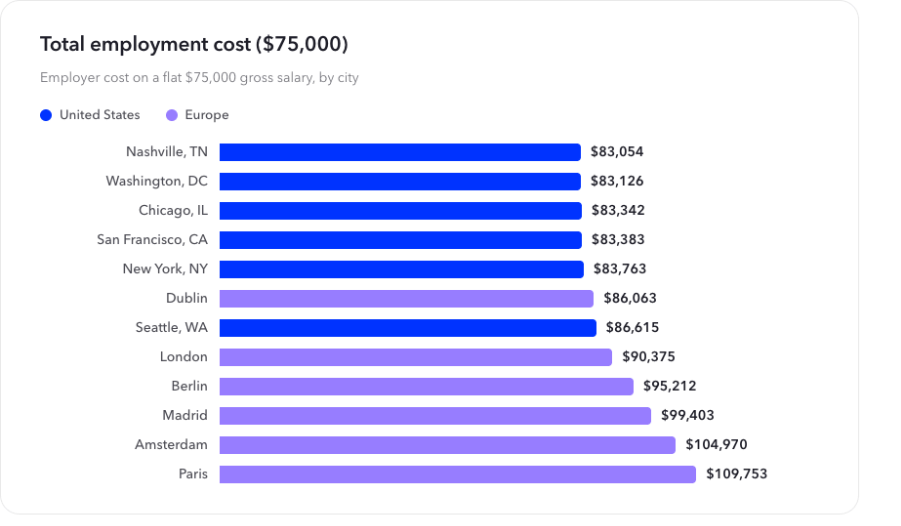
On the US side, employer costs are tight and predictable. Five of six cities sit within $710 of each other, between $83,054 (Nashville) and $83,763 (New York). FICA (Social Security and Medicare) accounts for roughly 70% of the employer bill in every city. The only thing that moves the needle is state unemployment tax, which is why Seattle ($86,615) breaks the pattern. Washington state’s unemployment wage base is $78,200. In California and Tennessee, it is $7,000.
Europe looks nothing like this. The spread across six cities is $23,690. Dublin ($86,063) is the closest to the US cluster, with Irish employer contributions of 14.8%, a rate closer to American payroll tax than to anything else on the continent. London ($90,375) is next, at 20.5%.
After that, the costs climb quickly. Berlin ($95,212), Madrid ($99,403), and Amsterdam ($104,970) all sit well above any US city. Paris tops the table at $109,753. That is $26,370 more than San Francisco on exactly the same salary. France’s URSSAF social security system bundles health insurance, family allowances, pension, work accident coverage, and solidarity contributions into a single mechanism that accounts for roughly two-thirds of the employer bill.
Employee net pay ($75,000)
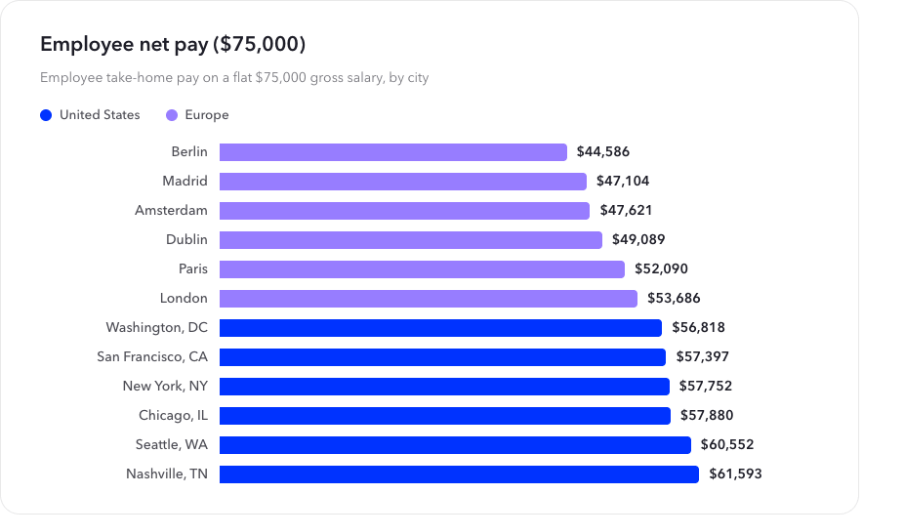
Every US city delivers higher net pay than every European city at this salary level.
Nashville leads at $61,593 (82.1% of gross). Tennessee has no state income tax, so employees there pay only federal income tax and FICA. Seattle is close behind at $60,552, with the remaining US cities between $56,818 and $57,880.
London ($53,686) produces the strongest European outcome, keeping 71.6% of gross and sitting closest to the US range. Dublin follows at $49,089. Berlin comes in lowest at $44,586. That is $17,007 less than Nashville on the same salary.
One comparison worth flagging is that Amsterdam ($47,621) and Madrid ($47,104) deliver almost identical net pay to the employee, despite Amsterdam costing the employer $5,567 more. The extra spending in Amsterdam goes entirely into statutory contributions. The employee does not see any of it. What you pay and what the hire receives are shaped by different parts of each system.
Local market salaries: Charts and analysis
The $75,000 view shows you how each system works. This section shows you what it actually costs for each hire at local market rates.
Median local gross salary by city
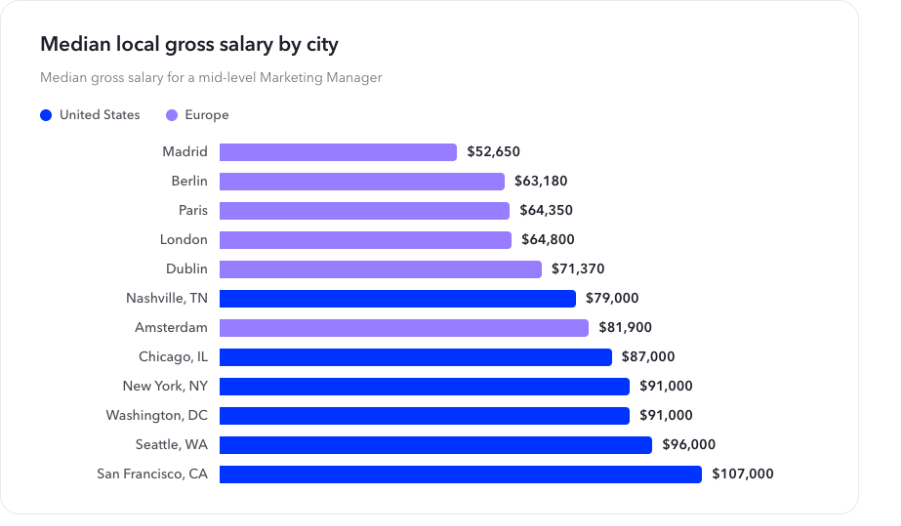
US salaries are consistently and substantially higher. The six US cities average $91,833. The six European cities average $66,375. That is a 38% premium.
San Francisco ($107,000) sits at the top. Madrid ($52,650) sits at the bottom. Amsterdam ($81,900) is the only European city that pays more than Nashville ($79,000), the lowest-paying US city.
A hire in Europe, will result in lower salary costs. The question is what happens when employer contributions are added on top.
Total employment cost at local rates
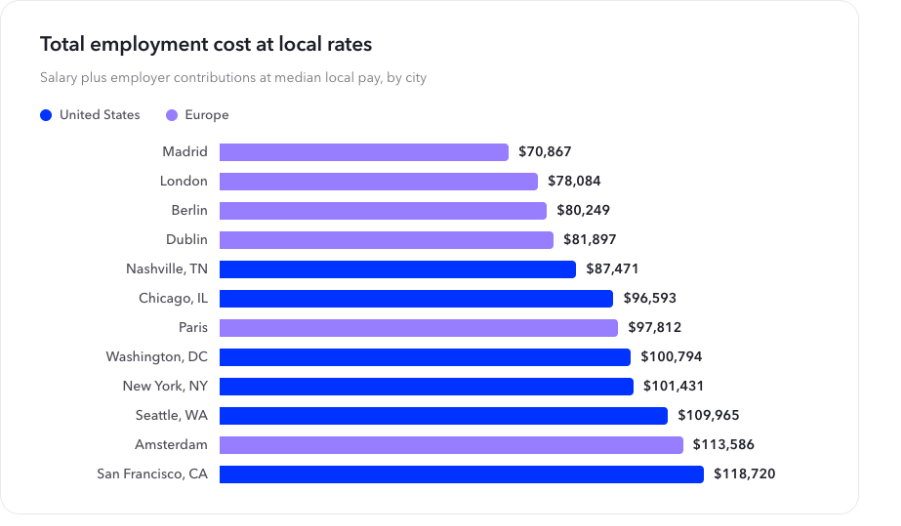
This is where the $75,000 view breaks down.
San Francisco ($118,720) is now the most expensive city in the set. Amsterdam ($113,586) and Seattle ($109,965) follow. Four of six European cities, Madrid ($70,867), London ($78,084), Berlin ($80,249), and Dublin ($81,897), cost less than Nashville ($87,471), the cheapest US option.
Paris is the European exception that proves the rule. A local salary of $64,350 (lower than Nashville’s $79,000) still produces a total cost of $97,812, higher than Nashville. France’s employer contribution structure is heavy enough to push a lower salary past a higher one. If you are comparing Paris against a US city, the contribution layer will override the salary difference.
For the other four European cities, the lower local salary more than offsets the higher employer contributions. This is the core trade-off in the US vs Europe comparison, and it flips the $75,000 view on its head.
Employee net pay at local market rate
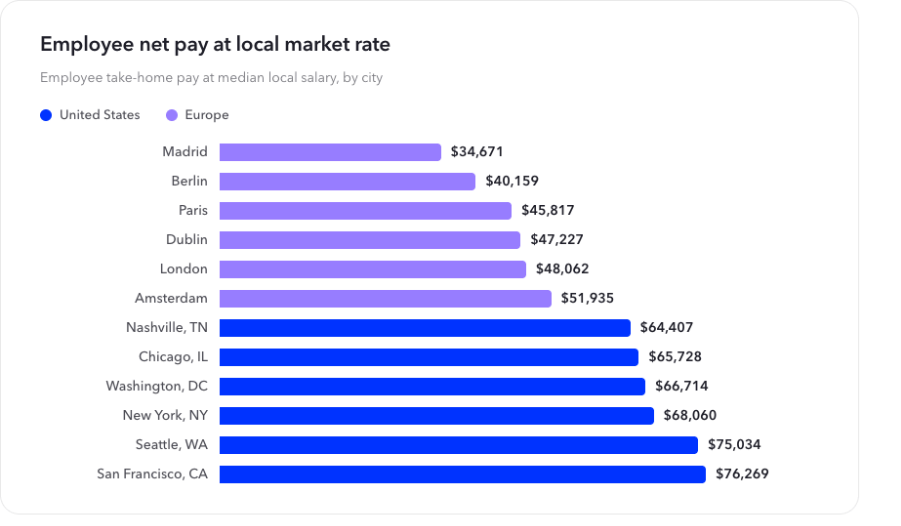
Higher US salaries translate directly into higher take-home pay. Every US city produces higher net pay than every European city, even at local rates.
Nashville employees keep $64,407 on a $79,000 salary. Amsterdam employees keep $51,935 on an $81,900 salary. Amsterdam pays more in gross but delivers less in net. The highest European net pay figure is still $12,472 below the lowest US one.
For hiring conversations, this matters. A European offer that looks competitive on gross salary can feel very different to the candidate once local deductions are applied. If hiring in a market like Berlin or Madrid, where net pay sits well below $45,000, Companies need to think about total compensation more broadly to stay competitive with candidates who have US offers on the table.
What this means for your hiring plans
On the same salary, European employer costs are 2.5 times higher than in the US.
On a $75,000 benchmark, US employer costs average $8,881. European employer costs average $22,629. Paris alone adds $34,753 in employer contributions, more than four times the US average. If budgeting for a European hire using US payroll costs as a reference point, the package will be underestimated.
Employer cost and employee take-home pay do not move together
Amsterdam costs the employer $5,500 more than Madrid ($104,970 vs $99,403), yet both employees take home almost the same amount ($47,621 vs $47,104). The additional spend in Amsterdam goes entirely into statutory contributions and never reaches the employee. London works the other way round. It carries one of the lower employer overheads in Europe ($15,375) while delivering the highest employee net pay ($53,686). Both sides need to be modelled separately when building compensation packages.
Dublin is the only European city in this study with employer costs comparable to the US
At the $75,000 level, Irish employer contributions of 14.8% ($11,063) sit between Seattle (15.5%) and the US average (11.8%). No other European city in the set comes below 20%. For companies that need a European presence with a cost structure closer to what they are used to at home, Ireland is the most natural fit.
At local market salaries, most of Europe costs less than the cheapest US city
Marketing Managers earn 38% more on average ($91,833 vs $66,375), and that salary premium reverses the cost picture. Four of six European cities cost less than Nashville ($87,471), the lowest-cost US option. The exceptions are Paris and Amsterdam. Paris is worth particular attention. A local salary of $64,350, lower than Nashville’s $79,000, still produces a total cost of $97,812 because France’s employer contribution structure adds enough to push a lower salary past a higher one.
US employer costs are consistent. European costs depend entirely on the country
At the $75,000 benchmark, five of six US cities sit within a $710 window of each other on total employer cost. The spread across six European cities is $23,690. Each European country operates a different contribution structure with different rates, caps, and mandatory charges. The only way to know what a hire will cost in a given European market is to run the numbers for that specific country.
Ready to hire in Europe?
This study covers the statutory costs. But if you have actually tried to hire someone in a European country you do not have a presence in, you will know the costs are only the beginning. There are local contracts to get right, payroll to run in the right currency at the right time, benefits that vary by market, and termination rules that can catch you out if you are not set up for them.
That is what we do. Boundless, a Payoneer company is an Employer of Record covering over 110 countries, with a team that knows European employment particularly well. We handle the contract, payroll, contributions, and compliance in their country to ensure legal hire in every country. No entity needed, no guesswork on local obligations, we take care of it all.
If you have a hire in mind or you are still working out where in Europe makes sense, we are happy to talk through the numbers and what to expect. Get in touch.
Hire & pay globally with Payoneer Workforce Management
- Expand internationally in 160+ countries
- Run global payroll securely in a few clicks
- Stay compliant with local employment laws
- Let Payoneer Workforce Management manage benefits, work permits, timesheets, and more so you don’t have to


Schedule a demo
Related resources

Planning to hire employees in Bulgaria? Here’s a quick guide
Learn how to hire employees in Bulgaria. Covers contracts, work permits, payroll, leave laws, and how Payoneer Workforce Management supports compliance.

Employment laws in Bulgaria
Learn about labor laws compliance in Bulgaria, including contracts, working hours, statutory rights, termination, notice periods, and severance.

Employment laws in Israel
Learn about employment laws in Israel, from contract terms to working hours, from minimum wage to mandatory benefits. Ensure labor law compliance in Israel.
Leave policy in Israel
Explore the leave policy in Israel covering annual leave, sick leave, maternity, paternity leave, and public holidays. Stay compliant with leave laws in Israel.
Your guide to payroll in Bulgaria
Learn how payroll in Bulgaria works, covering income tax, social security, minimum wage, payslip rules, and how to stay compliant after euro adoption.
Leave policy in Bulgaria
A guide to leave laws in Bulgaria, covering annual leave, public holidays, sick leave, maternity and paternity leave, and statutory leave entitlements.

Employment laws in Austria
Labor laws compliance in Austria explained: contracts, working hours, mandatory benefits, notice periods, severance, and key statutes every employer needs.
Leave policy in Austria
Understand leave laws in Austria covering annual leave, sick pay, maternity, paternity, parental leave, and other statutory entitlements that employers must offer.
Your guide to payroll in Austria
Pay employees in Austria with confidence. Guide covers wages, Lohnsteuer, social insurance, employer costs, payslip rules, and ÖGK reporting requirements.
Latest articles
-

US vs Europe Employment Costs and Net Pay Compared: 2026 Study
How much does it really cost to hire in Europe versus the US? Explore a data-backed comparison of statutory employer costs, local salaries, and net pay across 12 leading cities.
-
Enabling Singapore-Based Businesses to Structure and Scale Across ASEAN: A Guide for Corporate Service Providers
Learn how corporate service providers can help Singapore-based businesses structure, manage and scale their ASEAN operations through effective entity design, financial infrastructure planning and regional compliance frameworks.
-
Cross-Border Expansion Trends and What They Mean for Corporate Service Providers
As client expansion strategies evolve, corporate service providers must adapt. Explore the key cross-border expansion trends shaping demand for regional structuring, compliance, governance and financial infrastructure support.
-
Voice Search Optimization for Global Businesses: Preparing for the Future of Financial SEO
Learn how financial services can optimize for voice search and AI‑driven search assistants. Explore strategies to stay ahead in a voice‑first world.
-
What Is a Virtual Business Bank Account?
Learn what a virtual business bank account is, how it works, and why modern businesses rely on digital accounts for faster, global payments.
-
The Role of Social Proof: How to Boosts Payment Platform Credibility
Learn how social proof such as testimonials, reviews and user‑stories enhances credibility for online payment platforms. Discover strategies for fintechs and payments businesses.






Disclaimer
The information in this article/on this page is intended for marketing and informational purposes only and does not constitute legal, financial, tax, or professional advice in any context. Payoneer and Payoneer Workforce Management are not liable for the accuracy, completeness or reliability of the information provided herein. Any opinions expressed are those of the individual author and may not reflect the views of Payoneer or Payoneer Workforce Management. All representations and warranties regarding the information presented are disclaimed. The information in this article/on this page reflects the details available at the time of publication. For the most up-to-date information, please consult a Payoneer and/or Payoneer Workforce Management representative or account executive.
Availability of cards and other products is subject to customer’s eligibility. Not all products are available in all jurisdictions in the same manner. Nothing herein should be understood as solicitation outside the jurisdiction where Payoneer Inc. or its affiliates is licensed to engage in payment services, unless permitted by applicable laws. Depending on or your eligibility, you may be offered the Corporate Purchasing Mastercard, issued by First Century Bank, N.A., under a license by Mastercard® and provided to you by Payoneer Inc., or the Payoneer Business Premium Debit Mastercard®, issued and provided from Ireland by Payoneer Europe Limited under a license by Mastercard®.
Skuad Pte Limited (a Payoneer group company) and its affiliates & subsidiaries provide EoR, AoR, and contractor management services.
