
There’s no silver bullet: A case for picking and mixing payment provider traits
The Forrester Wave Report is a respected voice in research. It can help you choose a suitable merchant payment platform. However, the simple graph doesn’t tell the full story. It oversimplifies the payment platform possibilities. We look at ways to make their data relevant for you.


The payments market has been in a funny place during these last few years. Having been on the inside of the industry shift as banks stopped being the payment providers of choice and successful tech companies were formed, the three overriding knowledge points I’ve gained are:
Each merchant has their own requirements and they should understand those better before making a selection of provider
Since there’s so much investment in the payment industry, it’s important to understand where your potential partners are in their journey.
There is no silver bullet – no one single provider who performs the best in every scenario imaginable – and it’s hard to see one forming in the next five years.
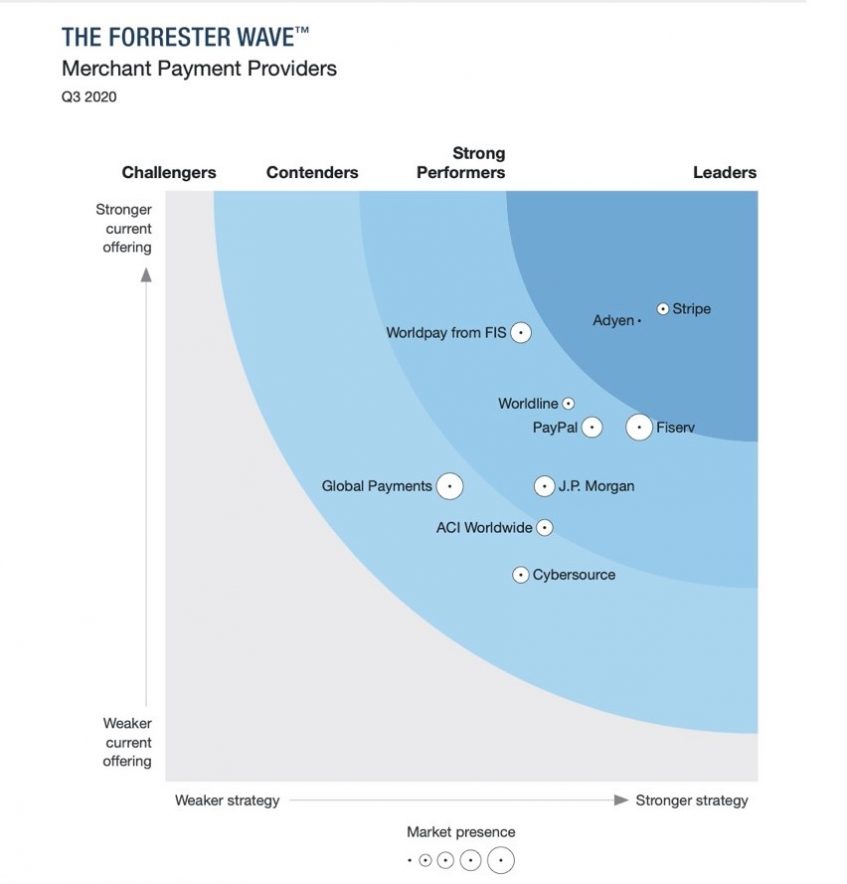
Source: The Forrester Wave™: Merchant Payment Providers, Q3 2020
If you blindly look towards the top-right of the Forrester diagram you could easily make a less than optimal purchase decision for your business. This is the second Forrester report produced since 2018 and since that last report there’s been a lot of movement which isn’t fully explained. Thus, judging this change with a simple graph oversimplifies the payments landscape and merchant needs. There are a couple of providers that I would say are missing,
Whatever the reason for this, it would be interesting to see how Forrester would have ranked them.
Here are a few key points which are worth calling out.
Customers need to make the scoring relevant for them
Forrester has provided their score ranking which I encourage customers to review contextualize to their own business. Some will place a lower value towards omnichannel while some will give more value to Payouts & Disbursements. Relating this to your company needs is very important and impactful.
There are categories that I think have been missed and would also be important factors to consider. These include:
- commercial attractiveness
- acceptance rates across markets
- support model
- linking payment
- data to loyalty
- and optimization
Depending on your individual requirements, adding these categories could have a significant impact on the ranking of these suppliers.
I have been working in this industry for many years now and was privileged to have seen how some providers on this list are doing amazing things for their customers. Those great things were not included in this report, but they absolutely are a solid reason why the businesses selected their providers. I think, in producing this report, Forrester made some simplifications in explaining customer needs. This distorts the graph and re-emphasizes why personalizing your provider decision to your individual needs is a must.
One payment provider might not be enough
I just left a webinar with a customer of ours who stated: “We selected multiple payment providers for a couple of reasons. Firstly, we didn’t want to commit ourselves to one provider for many years as we deemed this too risky and, secondly, we couldn’t find a payment provider that met all our needs”. This highlights that picking and mixing the best parts of each payment provider is also a strategy many merchants take.
We see this with the ones who particularly understand the value of payments, but it’s definitely not the right scenario for many other merchants. There are providers on this list that are perfect for particular situations as a single supplier.
Oversight of them all
Working with all the providers from the strong performers and leaders categories, we see many happy customers, we see which providers are gaining the most customers and we see how they are helping their customers always be better. As a software service, we enjoy the privilege of sitting alongside customers and unlocking this value with their providers.
We also empathize with our customers as we see the challenges in choosing the right provider(s) for their business. It’s a fast moving industry with new names, upcoming names, and news almost every day. This is also just one part of commerce – we haven’t even touched on payment methods or fraud providers.
Summary
Ultimately, it’s very useful to see an independent review of the payments industry. While understanding the criteria to be part of this report it would still be interesting to see big domestic players in here and how they stack up against these global names, particularly in countries like Japan, Korea, China, Brazil where there are significant nuances.
The real takeaway for me is that customers need to adjust the weighting, consider if there are missing categories from the criteria and apply this information in a relevant way. And of course, as always, they should speak to those reference customers and the community.
I’d love to take predictions from everyone on what the graph will look like in 2 years time!
Related resources

Employment laws in Jamaica
A complete guide to employment laws in Jamaica. Learn about minimum wage, working hours, termination laws, and other employee rights in Jamaica.

Your guide to payroll in Jamaica
Simplify Jamaica payroll processing with clear insights on taxes, social security, compliance, and pay cycles for accurate and efficient management.
Planning to hire employees in Jamaica? Here’s a quick guide
Hiring talent in Jamaica? Learn everything you need to know about engaging a team and streamlining the hiring process in Jamaica.

Your guide to payroll in Switzerland
Streamline Switzerland payroll processing with clear insights on taxes, social security, compliance, and pay cycles for accurate payroll management.
Planning to hire employees in Switzerland? Here’s a quick guide
Hire employees in Switzerland with ease. Learn what hiring in Switzerland involves, contracts, payroll, laws, and how Payoneer Workforce Management can help.

Employment laws in South Korea
A clear guide to labor law compliance in South Korea, covering contracts, working hours, statutory benefits, and termination rules for global employers.
Leave policy in South Korea
Employers' guide to leave laws in South Korea, detailing annual leave, public holidays, sick leave, parental leave, and other statutory entitlements under South Korean labor law.

Employment laws in New Zealand
Understand the employment laws in New Zealand, right from contracts, leaves, working hours, wages, benefits, etc., and how Payoneer Workforce Management can support labor law compliance in New Zealand.
Leave policy in Switzerland
Explore employee leave policy in Switzerland, including public holidays, annual leave entitlements, maternity and paternity leaves, etc.
Latest articles
-

Employment laws in Jamaica
A complete guide to employment laws in Jamaica. Learn about minimum wage, working hours, termination laws, and other employee rights in Jamaica.
-
Your guide to payroll in Jamaica
Simplify Jamaica payroll processing with clear insights on taxes, social security, compliance, and pay cycles for accurate and efficient management.
-
Planning to hire employees in Jamaica? Here’s a quick guide
Hiring talent in Jamaica? Learn everything you need to know about engaging a team and streamlining the hiring process in Jamaica.
-
Your guide to payroll in Switzerland
Streamline Switzerland payroll processing with clear insights on taxes, social security, compliance, and pay cycles for accurate payroll management.
-
Planning to hire employees in Switzerland? Here’s a quick guide
Hire employees in Switzerland with ease. Learn what hiring in Switzerland involves, contracts, payroll, laws, and how Payoneer Workforce Management can help.
-
Employment laws in South Korea
A clear guide to labor law compliance in South Korea, covering contracts, working hours, statutory benefits, and termination rules for global employers.



Disclaimer
The information in this article/on this page is intended for marketing and informational purposes only and does not constitute legal, financial, tax, or professional advice in any context. Payoneer and Payoneer Workforce Management are not liable for the accuracy, completeness or reliability of the information provided herein. Any opinions expressed are those of the individual author and may not reflect the views of Payoneer or Payoneer Workforce Management. All representations and warranties regarding the information presented are disclaimed. The information in this article/on this page reflects the details available at the time of publication. For the most up-to-date information, please consult a Payoneer and/or Payoneer Workforce Management representative or account executive.
Availability of cards and other products is subject to customer’s eligibility. Not all products are available in all jurisdictions in the same manner. Nothing herein should be understood as solicitation outside the jurisdiction where Payoneer Inc. or its affiliates is licensed to engage in payment services, unless permitted by applicable laws. Depending on or your eligibility, you may be offered the Corporate Purchasing Mastercard, issued by First Century Bank, N.A., under a license by Mastercard® and provided to you by Payoneer Inc., or the Payoneer Business Premium Debit Mastercard®, issued and provided from Ireland by Payoneer Europe Limited under a license by Mastercard®.
Skuad Pte Limited (a Payoneer group company) and its affiliates & subsidiaries provide EoR, AoR, and contractor management services.
