
How to send or schedule payments to your recipient’s bank account
At Payoneer, our focus is always on helping you pay and get paid quicker and easier than ever – wherever your team is based. We understand that speed and certainty are crucial for any business. That’s why we make it easy to pay your contractors, employees, or suppliers straight to their bank account. By sending…


At Payoneer, our focus is always on helping you pay and get paid quicker and easier than ever – wherever your team is based.
We understand that speed and certainty are crucial for any business. That’s why we make it easy to pay your contractors, employees, or suppliers straight to their bank account. By sending or scheduling payments directly to your recipient’s bank account, you get complete control over all your outgoing payments.
This capability has long been enjoyed by Payoneer users because:
- Paying international contractors, suppliers, and employees is made simple, quick, and secure. In just a few clicks, you can send payments globally from the funds held in your account.
- Scheduling payments means you’ll never miss or forget another payment. Whenever it’s convenient for you, simply schedule all your outgoing payments and free yourself from having to sign in on the specific payment dates.
- Batch payments allow you to send up to 1,000 payments worldwide at the click of a button, saving you time and energy when paying recurring invoices or making multiple payments at the same time.*
To start paying your contractors, suppliers, and employees directly to their bank accounts, simply follow these steps:
- Click Pay in the main menu and then select Pay to a recipient’s bank account.

- If you want to schedule your payment, toggle the slider and input your chosen payment date. For immediate payments, simply add your payment details (select the balance you want to use, choose the bank account you want to transfer funds to, enter the amount you want to transfer, and add an optional reference number and description). Once you’re ready to make your payment, click Review.
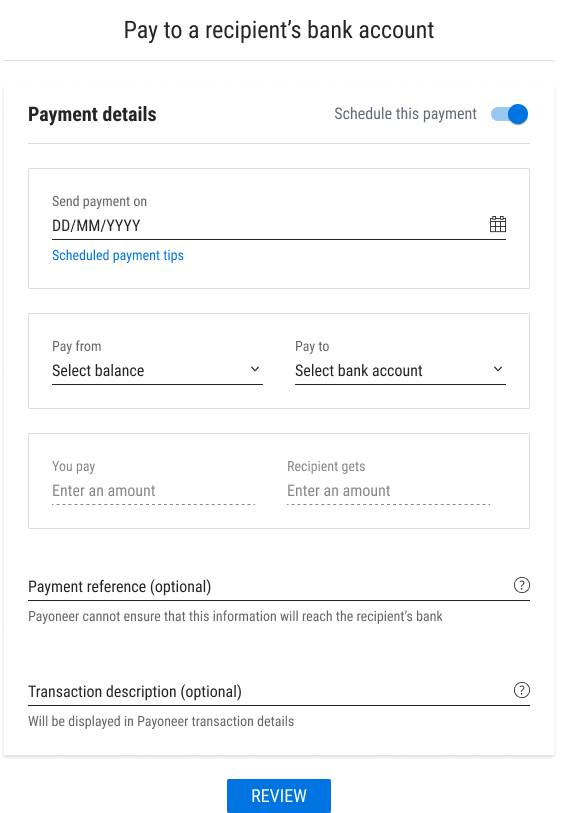
- Make a final check of the payment details and either click Pay or Schedule payment.

- You’ll then see a confirmation screen containing your transaction ID (and a payment date for any scheduled payments).
Sending or scheduling payments to your recipient’s bank account makes processing payments quick, easy, and gives you complete control over your outgoings. Try it today!
Note: If this is your first time paying to a recipient’s bank account, at step 2 click Add bank details and then select Add bank account. Once you’ve entered the necessary details, we’ll review your instruction and send it for bank approval – making your entire payment process speedy and smooth.
Related resources

VIDEO TEMPLATE GUIDE
SWIFT connects 11,000+ banks worldwide, powering secure international transfers. This guide explains how SWIFT works, why it’s still widely used, how to find your SWIFT code, and how Payoneer helps…


Summary and Quick Answer Example

Payoneer Account: How to open and how much does it cost?
What is it? Payoneer account, what are the types, and why it is beneficial for Ukrainian business. Also learn about taxation and who Payoneer is not suitable for.

Reduce Payoneer Costs: Strategies for Cost Savings
Find out how to withdraw money from Payoneer to Ukraine: an overview of banks, types of accounts, and advice on how to minimize commissions and risks

How to withdraw money from Payoneer to Ukraine
Find out how to withdraw money from Payoneer to Ukraine: an overview of banks, types of accounts, and advice on how to minimize commissions and risks

Guide to payment gateways in Pakistan
Explore major payment gateways in Pakistan to see which one will work for your business. Find out what a gateway is and how to set it up on your website.

Payoneer, SWIFT and ACH Transfers: What’s the Difference?
If you're a Ukrainian freelancer, entrepreneur, or business owner working with international clients, you've likely faced this question: What’s the best way to receive cross-border payments? SWIFT transfers, ACH, and…
The Best Ways to Receive Payment Online as an International Business
International payments don’t have to be slow or expensive. This guide compares methods like SWIFT and ACH, explains common challenges, and shows how Payoneer simplifies global payments with multi-currency accounts…

Best Online Payment Systems for a Small Business
Small businesses need secure, fast ways to accept payments. This guide compares top processors like PayPal, Stripe, Square, and Payoneer, outlining key features, fees, setup steps, and why Payoneer is…
Latest articles
-

What’s Actually Disrupting Cross-Border Businesses Right Now: Payoneer Global Business Sentiment Survey, Q2 2026
Based on a survey of 8,626 businesses across 20 countries, conducted in May 2026.
-
When to Scale Your VA Business: 5 Signs You’re Ready to Build an Agency in the Philippines
The Philippines has become one of the world’s leading sources of virtual talent. But many Filipino virtual assistants aren’t just building freelance careers anymore — they’re quietly building export businesses. Here’s how to know if you’ve already made the transition.
-
Test: Global money transfers: How to make safe international transactions
In our interconnected world, global money transfers are an essential part of business and personal finance. Whether you’re a small business owner expanding into international markets, a freelancer working with clients abroad, or a consumer purchasing products from another country, understanding how to transact safely on a global scale is crucial.
-
VIDEO TEMPLATE GUIDE
SWIFT connects 11,000+ banks worldwide, powering secure international transfers. This guide explains how SWIFT works, why it’s still widely used, how to find your SWIFT code, and how Payoneer helps you receive global payments efficiently.
-
Invoices, Receipts and Proof of Payment: Tips and Templates
Everything you need to create invoices, receipts, and proof of payment documents, including examples and best practices for businesses in Pakistan.
-
Making International Payments From Pakistan: The Methods, Steps and Best Practices
Learn the best ways to send and receive international payments from Pakistan, including secure methods and tips to reduce costs.






Disclaimer
The information in this article/on this page is intended for marketing and informational purposes only and does not constitute legal, financial, tax, or professional advice in any context. Payoneer and Payoneer Workforce Management are not liable for the accuracy, completeness or reliability of the information provided herein. Any opinions expressed are those of the individual author and may not reflect the views of Payoneer or Payoneer Workforce Management. All representations and warranties regarding the information presented are disclaimed. The information in this article/on this page reflects the details available at the time of publication. For the most up-to-date information, please consult a Payoneer and/or Payoneer Workforce Management representative or account executive.
Availability of cards and other products is subject to customer’s eligibility. Not all products are available in all jurisdictions in the same manner. Nothing herein should be understood as solicitation outside the jurisdiction where Payoneer Inc. or its affiliates is licensed to engage in payment services, unless permitted by applicable laws. Depending on or your eligibility, you may be offered the Corporate Purchasing Mastercard, issued by First Century Bank, N.A., under a license by Mastercard® and provided to you by Payoneer Inc., or the Payoneer Business Premium Debit Mastercard®, issued and provided from Ireland by Payoneer Europe Limited under a license by Mastercard®.
Skuad Pte Limited (a Payoneer group company) and its affiliates & subsidiaries provide EoR, AoR, and contractor management services.
