
Trusted by global businesses across industries
Our clients include SaaS, logistics, e-commerce companies across sectors that are looking to grow their business globally. Become one of them.


Expand in 160+ countries without setting up a local entity.
Employer of Record
Onboard, pay, and manage global employees on our unified platform.
Agent of Record
Pay, and manage global contractors internationally, with support to mitigate misclassification risks.
Contractor Management System
Pay your contractors seamlessly in 70 currencies.
A smoother way to handle global workforce operations
Get assistance to manage employment, payroll, benefits, contractors, and more in one platform, giving you clearer control over every stage of your global workforce.

Global onboarding, streamlined
Onboard contractors and employees seamlessly, with support for navigating local requirements:
- Estimate and review employment costs in different countries
- Assistance to create locally compliant employment agreements
- Guidance on collecting the required employment documentation
- Support to facilitate work devices
Flexible payment options for global teams
Pay your employees and contractors in 70 currencies, through a wide range of payment methods:
- Invoice payments
- Credit card
- Direct bank transfer
- Wire Transfer
- ACH Transfer
Plus, you can manage bulk payments, invoicing, deductions, pay slips and more, in a few clicks.


Guidance for localized benefits
When hiring contractors or employees globally, we provide guidance on local benefit options and support for managing timesheets, expenses, and other employment needs through our comprehensive platform.
Stay compliant with local laws
With legal and compliance support in 160+ countries, we help you navigate changing employment laws and reduce potential risks when engaging international talent.

We can help you build a dream global team


Talent discovery
Support to help you identify candidates from around the world.

Background checks
Tools and guidance to help you verify information and assess fit.

Coworking spaces and equipment
Facilitate workspace access and devices when needed.

Visas and work permits
Guidance to help you understand eligibility and application processes.
Global Hiring Toolkit
From local salary benchmarks to employment costs, learn all you need to know about hiring, paying, and managing an international team.
Global hiring guides
Explore and benchmark salaries
Employee cost calculator
PRICING
Transparent. Trusted. Scalable.
Employer of Record
(EOR)
Hire, pay and manage employees
Starts at
$199
per employee/month
Features
- Local employment agreements
- Personalised onboarding support
- Process payroll in 70+ currencies
- Labor law and tax compliance
- Benefits administration options
- Dedicated account managers
- Help center access
- Unified dashboard + third-party integrations
Agent of Record
(AOR)
Engage, pay and manage contractors
Starts at
$99
per contractor/month
Features
- Support with contracts
- Streamlined contractor onboarding
- Compliant contractor payments in 70+ currencies
- Support mitigating misclassification risks
- Dedicated account managers
- Help center access
- Unified dashboard + third-party integrations
Contractor Management System (CMS)
Handle contractor payments
Starts at
$19
per contractor/month
Features
- Contractor payments in 70+ currencies
- Invoice creation and tracking
- Expense submission and approvals
- Downloadable payment history
- Unified dashboard + integrations
- Mobile app access & localised support
Hire, onboard, pay, and manage your remote team with Payoneer Workforce Management
160+
Countries
covered
100%
Transparency in fee structure
70
Currencies
for payroll
24×5
Dedicated
support
More success stories

Ravi Bhalotia
Senior VP of Engineering, RemoteLock, United States
“Partnering with Payoneer Workforce Management has transformed our international hiring and onboarding processes. Their streamlined approach has enabled our tech team to scale effortlessly and efficiently. We now enjoy the freedom to focus on innovation, knowing our global talent strategy is in expert hands.”

Christopher Fellas
CEO, Insight Management Partners, Australia
“What I value most about Payoneer Workforce Management is its global reach and reliability. It’s a solution that grows with your business, whether you’re managing a handful of contractors or scaling across continents.”

Steve Badger
Global Head of Talent, OpenSolar, Australia
“Payoneer Workforce Management has been a trusted partner in our international expansion. Their onboarding process and compliance support have allowed us to focus on our core mission of accelerating the world’s transition from fossil fuels to solar energy.”

Sheikh Jafar Tarique
Founder and CEO of Aabhyasa Technologies, India
“We use Payoneer to pay our team members and receive payments from our international clients.”

Hooner Baweja
Founder & CEO, Hothaat Marketplace, India
“Using Payoneer has been one of the best things that has happened to our business this year. The Store Manager feature has helped us consolidate all our payments onto one platform and has significantly shorten our payment realization time.”

Daehyun Ko
Myungyoon Electronics, General Manager, South Korea
“Thanks to Payoneer, we can expand our business globally.” From B2B to B2C: how Myungyoon Electronics took control of its sales process to launch its products in the global market.

Nimisha and Manav
Co-founders, D’Moksha Homes, India
“Payoneer remains an integral part of our growth journey.” Find out how Manav and Nimisha Dhanda launched their sustainable homeware brand on the cusp of India’s national lockdown — and still managed to thrive.

Denys Shkribliak
Owner & Founder, Wood and Hearts Inc, Ukraine
“In the harsh times of war, when almost all manufacturing was lost, Payoneer became our real lifeline.” Find out how Wood and Hearts triumphed over adversity and rebuilt a company from the ashes of conflict.

Nitcharee Ujjin
Co-founder, Thumbinthai, Thailand
“Payoneer has been instrumental in helping us grow.” Thumbinthai co-founder Nitcharee Ujjin explains how the apparel start-up became a global powerhouse.
Trusted by businesses worldwide

Adham Aboelenein
Co-Founder & CEO, Anubis, Middle East & Africa
The previous payout workflow in Egypt for our contractors required several manual steps every pay cycle. With Payoneer Workforce Management, much of the process is now streamlined. Uploading data, generating invoices, and processing payments can typically be completed much more efficiently. Since adopting the Payoneer Workforce Management platform, we’ve been able to reduce the time we spend on monthly payment operations and reallocate that bandwidth toward growing our business.

Jon Santavy
Managing Partner, Simwell
Payoneer Workforce Management has been a game-changer for us, completely transforming the way we manage our global team. Payoneer Workforce Management’s digital onboarding has made our international payments as easy as our domestic ones. Payroll management that used to take hours is now error-free and takes just a few minutes.

Lavinia Davison
Global Head of Talent & Operations, OpenSolar
Payoneer Workforce Management, has been a key partner in our international expansion. Their seamless onboarding process and compliance expertise have allowed us to focus on our core mission which is to accelerate the world’s transition from fossil fuels to solar energy.

Brian Butcher
EVP, Corporate Development, PureRed
Payoneer Workforce Management made our team expansion possible, handling the complex onboarding and payroll processes across six different countries with ease. Their local expertise ensured our compliance, letting us focus on what we do best—serving our clients.

Bret Michaelsen
Human Resources Director, VRP Consulting
Payoneer Workforce Management’s solutions empowered us to scale our workforce globally with ease, ensuring timely payroll, compliance, and a seamless onboarding experience—all on one powerful platform.

Shaik Mohammed Shabaz
Head of Human Resources & Administration, Microsense
Payoneer Workforce Management simplified our contractor engagement from start to finish. Their platform covered onboarding, payments, and compliance, making our expansion into new markets practically frictionless.
Learning & Resources
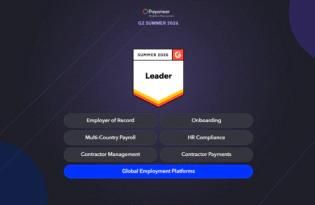
Payoneer Workforce Management named a leader across 12 categories in G2’s Summer 2026 reports
In G2’s Summer 2026 Reports, Payoneer Workforce Management earned leadership recognition across global workforce categories for its reliable payroll, onboarding, compliance, and Employer of Record solutions.


What Is Remittance? A Simple Guide for Indian Freelancers and Professionals
Remittance means transferring money across borders. If you receive payments from international clients or have family abroad sending money home, here is what you need to know.

Top Online Payment Systems and Ecommerce Payment Methods in India
Explore the top online payment systems for e-commerce businesses in India. Learn how to accept payments securely and efficiently with Payoneer's global solutions.

Planning to hire employees in Bulgaria? Here’s a quick guide
Learn how to hire employees in Bulgaria. Covers contracts, work permits, payroll, leave laws, and how Payoneer Workforce Management supports compliance.
Employment laws in Bulgaria
Learn about labor laws compliance in Bulgaria, including contracts, working hours, statutory rights, termination, notice periods, and severance.

Employment laws in Israel
Learn about employment laws in Israel, from contract terms to working hours, from minimum wage to mandatory benefits. Ensure labor law compliance in Israel.
Leave policy in Israel
Explore the leave policy in Israel covering annual leave, sick leave, maternity, paternity leave, and public holidays. Stay compliant with leave laws in Israel.
Your guide to payroll in Bulgaria
Learn how payroll in Bulgaria works, covering income tax, social security, minimum wage, payslip rules, and how to stay compliant after euro adoption.
Leave policy in Bulgaria
A guide to leave laws in Bulgaria, covering annual leave, public holidays, sick leave, maternity and paternity leave, and statutory leave entitlements.
Frequently asked questions (FAQs)
An Employer of Record (EOR) is a third-party organization that helps businesses engage and manage employees in other countries without setting up a local entity. Through an EOR, companies can manage payroll, benefits, and taxes more easily and help maintain compliance with local labor laws, while the company directs the employee’s daily work.
By partnering with an EOR, like Payoneer Workforce Management, businesses can expand into new markets efficiently, help reduce legal risks, and support the management of a global workforce.
An Employer of Record (EOR), like Payoneer Workforce Management, helps companies grow globally while reducing administrative complexities. It also helps cut the time and cost of setting up entities and simplifies cross-border hiring.
Beyond hiring and payroll, an EOR adds value by:
- Enabling market testing and rapid scaling without long commitments
- Providing predictable costs through consolidated payroll and invoicing
- Helps reduce the risk of legal exposure tied to misclassification and local employment rules.
- Giving access to vetted local benefits and HR support in the employee’s country
- Streamlining onboarding and offboarding with well-structured and compliant employment contracts.
- This lets businesses focus on strategy, customers, and team performance instead of admin work.
Payoneer’s Workforce Management platform helps your business grow globally by seamlessly engaging, managing, and paying talent through Employment of Record, Agent of Record, and contractor management services. With localized support in 160+ countries and territories, we make it easier for your business to onboard, pay and manage employees and contractors, while meeting local compliance requirements.
In the U.S., using an Employer of Record (EOR), like Payoneer Workforce Management, is a legal and recognized way to engage international employees. The EOR acts as the legal employer, managing payroll, taxes, and compliance in line with local labor laws.
However, regulations differ by market, and some countries have specific requirements for how employment arrangements must be structured or licensed. Partnering with a knowledgeable, compliant EOR helps businesses navigate these differences and help businesses engage global talent in a compliant manner.
An Agent of Record (AOR) is a third-party organization that helps companies engage and manage independent contractors or freelancers. The AOR helps handle contractor onboarding, contract management, payments, and compliance with local regulations, while the company communicates the contractor’s work and deliverables.
Partnering with an AOR, like Payoneer Workforce Management, helps businesses work with global contractors in a compliant manner, with proper classification, independent contractor agreements, and smooth payment processes across different markets.
Companies can work directly with independent contractors and freelancers, managing contracts and payments on their own. Others use freelance platforms or payment providers for short-term projects.
For long-term or larger-scale engagements, partnering with an Agent of Record (AOR) is one of the most reliable approaches. An AOR, like Payoneer Workforce Management, helps onboard contractors, supports with creating independent contractor agreements, helps manage payments in local currencies, and helps maintain proper worker classification per local laws. This allows companies to work with global talent confidently and helps them stay compliant across markets.
A Contractor Management System (CMS) is a digital platform that helps companies manage their independent contractors and freelancers in one place. It streamlines key processes like contract management, project tracking, invoicing, and payments.
A CMS gives companies better visibility over their contractor workforce, helping maintain accurate payments and proper documentation. When paired with an Agent of Record (AOR), it simplifies every stage of global contractor management.
To pay international contractors in local currency, companies can use global payment platforms, international wire transfers, a Contractor Management System (CMS), or partner with an Agent of Record (AOR) to engage international contractors.
With a CMS, businesses can track invoices, automate payment approvals, and pay contractors accurately and on time in their local currency. When paired with an AOR, companies can simplify and centralize global contractor management.
Hire & pay globally with Payoneer Workforce Management
- Expand internationally in 160+ countries
- Run global payroll securely in a few clicks
- Stay compliant with local employment laws
- Let Payoneer Workforce Management manage benefits, work permits, timesheets, and more so you don’t have to


Schedule a demo
Disclaimer
- Skuad Pte Limited (a Payoneer group company) and its affiliates & subsidiaries provide EoR, AoR, and contractor management services.
- The information in this article/on this page is intended for marketing and informational purposes only and does not constitute legal, financial, tax, or professional advice in any context. Payoneer and Payoneer Workforce Management are not liable for the accuracy, or reliability of the information provided herein. Any opinions expressed are those of the individual author and may not reflect the views of Payoneer or Payoneer Workforce Management. All representations and warranties regarding the information presented are disclaimed. The information in this article/on this page reflects the details available at the time of publication. For the most up-to-date information, please consult a Payoneer Workforce Management representative or account executive.
- Availability of cards and other products is subject to customer’s eligibility. Not all products are available in all jurisdictions in the same manner. Nothing herein should be understood as solicitation outside the jurisdiction where Payoneer Inc. or its affiliates is licensed to engage in payment services, unless permitted by applicable laws. Depending on or your eligibility, you may be offered the Corporate Purchasing Mastercard, issued by First Century Bank, N.A., under a license by Mastercard® and provided to you by Payoneer Inc., or the Payoneer Business Premium Debit Mastercard®, issued and provided from Ireland by Payoneer Europe Limited under a license by Mastercard®.
