
Payroll solutions for 1099 and W2 employees
Managing a hybrid team? Here’s a quick guide to payroll solutions for 1099 and W2 employees—so you can find the right platform without the guesswork.


Navigating payroll solutions for 1099 and W2 employees can feel like managing two completely different playbooks, like you’re juggling two completely different systems. From tax compliance and contractor classification to international payments and reporting, businesses need a unified approach that’s built to handle complexity without increasing risk.
In this post, we’ll break down your options for managing a blended workforce, highlight common payroll challenges, and help you choose a solution that works for both employee and contractor needs. Typically, payments made to 1099 contractors cannot be referred to as payroll; however, to ease readability, we use the term payroll solution in this article.
What’s the difference between payroll solutions for 1099 and W2 employees?
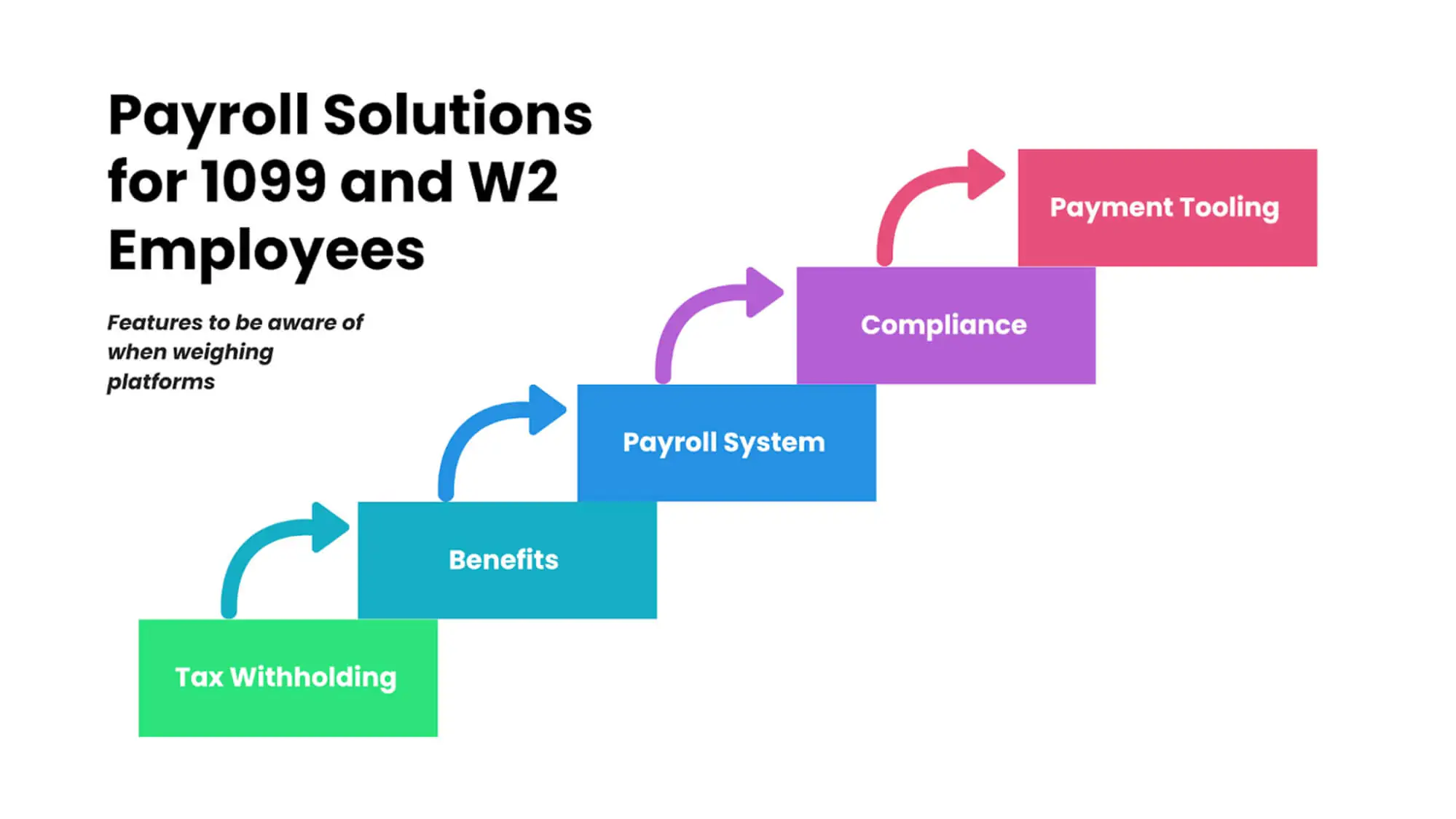
The core distinction between payroll solutions for 1099 and W2 employees comes down to classification, tax, and legal obligations. These are outlined in the following table for ease of understanding.
Payroll solution differences between W2 employees and 1099 contractors
| Feature | 1099 Contractors | W2 Employees |
|---|---|---|
| Tax Withholding | Contractor handles their own | The employer is responsible (Should File Form W-2) |
| Benefits | Not eligible for employer benefits | Eligible for benefits like health insurance, PTO, etc. |
| Payroll System | Often invoice-based or milestone-based | Runs on a schedule (weekly, biweekly) |
| Compliance | Governed by contract and classification | Subject to employment laws |
| Payment Tooling (Payment method) | Often managed via invoicing and disbursement platforms | Typically managed through payroll software |
It’s imperative to get this distinction right, especially worker classification, since misclassified workers lead to serious financial and legal consequences.
What payroll solutions work best for a mixed workforce?
If you’re managing a hybrid workforce, there are a few payroll options that you can explore that can help you manage paying independent contractors effectively. Here are the three most popular.
| Global Workforce Management Platforms (e.g., Payoneer Workforce Management) | Full-Service Payroll Providers | Contractor-Only Platforms | |
|---|---|---|---|
| Handles W2 Employee Payroll | ✅ | ✅ | ❌ |
| Handles 1099 Contractor Payments | ✅ | ❌ | ✅ |
| Global Payment Support | ✅ | ❌ | ✅ |
| Contractor Classification Assistance | ✅ | ❌ | ✅ |
| Integrated Compliance Tools | ✅ | ✅ | ❌ |
| Ideal for Blended (W2 + 1099) Workforces | ✅ | ❌ | ❌ |
1) Global Workforce Management Platforms (Like Payoneer Workforce Management)
Payoneer Workforce Management supports both employees and contractors, offering a centralized platform that streamlines global payroll, classification, tax documentation, and compliance. It’s ideal for companies hiring internationally or scaling remote-first operations.
2) Full-Service Payroll Providers
These providers handle tax calculations, W2 filings, and employee benefits. They work well for traditional teams operating within the U.S.
3) Contractor-Only Platforms
These platforms are designed for freelancer-heavy teams, offering contractor payments and, in many cases, basic classification support. However, they typically lack the full capabilities needed to manage employee payroll.
Why Payoneer Workforce Management stands out
You don’t need separate systems or messy workarounds to manage your hybrid workforce. What you do need, however, is a platform built for how modern teams actually work. With Payoneer Workforce Management, you can:
- Streamline payroll for W2 employees and 1099 contractors
- Stay compliant in 160+ countries
- Issue timely global payments in 70 currencies
- Reduce misclassification risk with seamless support and documentation workflows
Ready to simplify your workforce payroll solutions?
When it comes to payroll solutions for 1099 and W2 employees, Payoneer Workforce Management helps reduce the complexity when managing hybrid workforces.
We’ve helped businesses of all sizes scale with confidence by simplifying global payroll, streamlining compliance, and giving teams the freedom to focus on what they do best: delivering exceptional solutions to their clients.
Request a free demo of Payoneer Workforce Management today and see how seamless payroll solutions for 1099 and W2 employees can be.
Frequently asked questions (FAQs)
Yes, with the caveat that most platforms are not built for both. While traditional payroll software may support basic payments to 1099 contractors functionality, only integrated solutions provide the end-to-end tools necessary to effectively manage both workers under one platform, especially when hiring globally.
- Classify workers correctly under local labor laws
- Collect Form W-9 and issue 1099-NEC forms
- Avoid treating one group like the other (e.g., treating an employee like a contractor or vice versa)
A comprehensive workforce management platform like Payoneer Workforce Management simplifies onboarding, tax documentation, and classification.
No, the process is different. W-2 employees have taxes withheld by the employer and receive benefits. 1099 contractors handle their own taxes, and employers only issue payments and, if required, a 1099 form.
You’ll report your W-2 income as wages and your 1099 income as self-employment income on your tax return. You may need to file additional forms like Schedule C and pay self-employment tax on your contractor earnings.
Yes, but only if the roles are completely separate. The work done as a contractor must be outside the scope of the employee’s regular duties and meet IRS guidelines for independent contractor classification.
Hire & pay globally with Payoneer Workforce Management
- Expand internationally in 160+ countries
- Run global payroll securely in a few clicks
- Stay compliant with local employment laws
- Let Payoneer Workforce Management manage benefits, work permits, timesheets, and more so you don’t have to


Schedule a demo
Related resources
Payoneer Workforce Management named a leader across 12 categories in G2’s Summer 2026 reports
In G2’s Summer 2026 Reports, Payoneer Workforce Management earned leadership recognition across global workforce categories for its reliable payroll, onboarding, compliance, and Employer of Record solutions.


Planning to hire employees in Bulgaria? Here’s a quick guide
Learn how to hire employees in Bulgaria. Covers contracts, work permits, payroll, leave laws, and how Payoneer Workforce Management supports compliance.
Employment laws in Bulgaria
Learn about labor laws compliance in Bulgaria, including contracts, working hours, statutory rights, termination, notice periods, and severance.

Employment laws in Israel
Learn about employment laws in Israel, from contract terms to working hours, from minimum wage to mandatory benefits. Ensure labor law compliance in Israel.
Leave policy in Israel
Explore the leave policy in Israel covering annual leave, sick leave, maternity, paternity leave, and public holidays. Stay compliant with leave laws in Israel.
Your guide to payroll in Bulgaria
Learn how payroll in Bulgaria works, covering income tax, social security, minimum wage, payslip rules, and how to stay compliant after euro adoption.
Leave policy in Bulgaria
A guide to leave laws in Bulgaria, covering annual leave, public holidays, sick leave, maternity and paternity leave, and statutory leave entitlements.

Employment laws in Austria
Labor laws compliance in Austria explained: contracts, working hours, mandatory benefits, notice periods, severance, and key statutes every employer needs.
Leave policy in Austria
Understand leave laws in Austria covering annual leave, sick pay, maternity, paternity, parental leave, and other statutory entitlements that employers must offer.
Latest articles
-

Payoneer Workforce Management named a leader across 12 categories in G2’s Summer 2026 reports
In G2’s Summer 2026 Reports, Payoneer Workforce Management earned leadership recognition across global workforce categories for its reliable payroll, onboarding, compliance, and Employer of Record solutions.
-
What Is Remittance? A Simple Guide for Indian Freelancers and Professionals
Remittance means transferring money across borders. If you receive payments from international clients or have family abroad sending money home, here is what you need to know.
-
Top Online Payment Systems and Ecommerce Payment Methods in India
Explore the top online payment systems for e-commerce businesses in India. Learn how to accept payments securely and efficiently with Payoneer’s global solutions.
-
Planning to hire employees in Bulgaria? Here’s a quick guide
Learn how to hire employees in Bulgaria. Covers contracts, work permits, payroll, leave laws, and how Payoneer Workforce Management supports compliance.
-
Employment laws in Bulgaria
Learn about labor laws compliance in Bulgaria, including contracts, working hours, statutory rights, termination, notice periods, and severance.
-
Employment laws in Israel
Learn about employment laws in Israel, from contract terms to working hours, from minimum wage to mandatory benefits. Ensure labor law compliance in Israel.





Disclaimer
The information in this article/on this page is intended for marketing and informational purposes only and does not constitute legal, financial, tax, or professional advice in any context. Payoneer and Payoneer Workforce Management are not liable for the accuracy, completeness or reliability of the information provided herein. Any opinions expressed are those of the individual author and may not reflect the views of Payoneer or Payoneer Workforce Management. All representations and warranties regarding the information presented are disclaimed. The information in this article/on this page reflects the details available at the time of publication. For the most up-to-date information, please consult a Payoneer and/or Payoneer Workforce Management representative or account executive.
Availability of cards and other products is subject to customer’s eligibility. Not all products are available in all jurisdictions in the same manner. Nothing herein should be understood as solicitation outside the jurisdiction where Payoneer Inc. or its affiliates is licensed to engage in payment services, unless permitted by applicable laws. Depending on or your eligibility, you may be offered the Corporate Purchasing Mastercard, issued by First Century Bank, N.A., under a license by Mastercard® and provided to you by Payoneer Inc., or the Payoneer Business Premium Debit Mastercard®, issued and provided from Ireland by Payoneer Europe Limited under a license by Mastercard®.
Skuad Pte Limited (a Payoneer group company) and its affiliates & subsidiaries provide EoR, AoR, and contractor management services.
